


Essential Qualities of a Slave
At its core, a Master/slave dynamic is not built on fantasy, but on structure, discipline, and lived reality. A well-suited slave understands this distinction clearly. She recognizes that the romanticized portrayals found in works like The Sleeping Beauty trilogy by Anne Rice or the Marketplace series by Laura Antoniou are, ultimately, fiction—stylized interpretations rather than sustainable frameworks for real life. What she brings instead is experience, or at least a grounded understanding of what structured relationships actually demand: consistency, patience, emotional resilience, and ongoing effort. She is not chasing fantasy; she is choosing a path that requires presence and intention.
Equally important is adaptability. A strong slave is a quick learner—someone who can absorb new information, adjust to evolving expectations, and apply what she learns in meaningful ways. This adaptability reflects a deeper form of self-control. Rather than being ruled by past experiences or rigid thinking, she is responsive, thoughtful, and capable of growth. She understands that structure does not mean stagnation; it means refinement over time.
There is also an element of willingness to explore—to step into the unknown with trust and courage. An adventuresome spirit, in this context, is not recklessness, but openness. She is committed to supporting her Master’s vision and direction, even when it stretches her comfort zone, because she trusts in the foundation they have built together. That trust transforms uncertainty into shared discovery rather than fear.
Moral character plays a critical role as well. A slave must be more than obedient; she must be principled. She communicates clearly and honestly, even when it is difficult. This includes having the moral courage to speak up if something feels misaligned or concerning. True service is not silent compliance—it is engaged, aware, and rooted in integrity. A Master relies on that honesty, because it strengthens the dynamic rather than undermines it.
As the saying goes, “The bondage of trust is stronger than any chain.” That trust is sustained through empathy and care. A slave who has experience in service understands that attentiveness, emotional awareness, and nurturing are not weaknesses—they are strengths. She is observant, responsive, and genuinely invested in the well-being of her Master and the relationship as a whole.
At the same time, she maintains a grounded and balanced perspective. She looks for the positive in situations, not out of blind optimism, but from a place of resilience. She also has clearly defined boundaries and understands how to communicate them. Paradoxically, it is this clarity around limits that allows for deeper trust and more meaningful surrender. Without boundaries, there is no true consent—only uncertainty.
Finally, a well-rounded slave often brings a diverse set of skills to her role. These can range from practical abilities—such as organization, administration, and managing responsibilities—to more refined interpersonal and aesthetic skills sometimes referred to as “courtesan skills.” These might include thoughtful presentation, engaging conversation, cultural awareness, and the ability to represent her Master with poise in social or professional environments. None of these are about performance for its own sake; they are expressions of intentional service, carried out with pride and care.
Altogether, these qualities reflect a person who is not passive, but deeply engaged—someone who chooses her role with awareness, upholds it with integrity, and grows within it over time.
Submission, Servitude, and Surrender in Slavery
Submission vs. slavery? ..... Submissives vs. slaves?
How often have the differences between these terms been discussed and debated? Far too many times, most likely. Nonetheless, there remains only the fuzziest distinction between submission and slavery throughout the BDSM community.
The distinction between them lies in the route taken to reach that endpoint and the individual's mindset upon arrival.
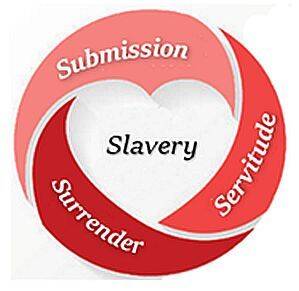
Submission
Primarily driven by self-interest and gives the authoritative figure the right to make decisions. It means the submissive has other choices available to her, but she chooses to give up control. Submission says: “I will give control to You when I choose to because I enjoy it.”
Surrender
Defined by self-sacrifice, servitude, and ceasing to resist the (consensual) authority imposed upon the slave. She no longer wants any choice other than to relinquish her control. Surrender says: “I chose for You to take control because You enjoy it.”
The Slave’s Declaration
I, [slave name], with a free mind and open heart, entreat [Master name] to accept my complete submission and surrender, accept my free will, and take me into His care and guidance as His valued possession so that we may grow together in love, honor, admiration, trust, and mutual respect.

The satisfaction of my Master’s wants, desires, needs, and whims is consistent with my desire as His slave to serve, obey, and be found pleasing to Him. To that end, I offer Him full use and ownership of my body, heart, mind, soul, devotion, time, attention, talents, experience, and abilities.
Further, I ask in sincere humility that my Master accept possession and the keeping of my physical body for the fulfillment and enhancement of our mutual sexual, spiritual, emotional, and intellectual needs. To achieve this, He may enjoy the unfettered use of my body and my sexuality at any time, in any place, and in any way as He pleases. I ask that He guide and direct any sexual, sensual, or scene-related responses and behavior in such a way as to further my growth as His slave.
My Master's symbols of ownership shall include the collar He presents to me and any future permanent marks or tokens He may wish to bestow, if any. Symbols of ownership are a tangible and visible reminder of my status as His slave and will be worn with great pride. They represent my Master's control and the total power exchange lifestyle we have chosen together.
I further request that my Master use His control, power, and authority over me to guide and shape me in His best judgment, thus assisting me in growing as a total being in strength, character, and confidence.
With my body, I Thee worship.
In return, I agree:
❖ To serve my Master and to obey His commands to the best of my ability.
❖ To maintain honest and open communications with Him.
❖ To reveal my thoughts, feelings, and desires without hesitation or embarrassment.
❖ To overcome any feelings of guilt, shame, or inhibitions that may interfere with my capability to serve Him or limit my growth and development as His slave.
❖ To inform Him of my wants and perceived needs, recognizing that He is the sole judge of whether or how these shall be satisfied.
❖ To strive toward the maintenance of a positive self-image and the development of realistic expectations and goals.
❖ To work with Him to become a happy and self-fulfilled individual.
❖ To address any negative aspects of ego or insecurity that may hinder progress toward these goals.
My submission, surrender, and free will are offered with the knowledge that nothing asked of me will demean me as a person and in no way diminish my responsibilities toward reaching my potential.
I do entreat this with full acceptance and the realization of what this means, both stated and implied, in the conviction that my offer will be understood and accepted in the spirit of care, faith, esteem, respect, admiration, and devotion in which it is given.
Eternally,
--- Your slave [Name]
The Slave’s Role + Responsibilities
The term “slave” is powerful, layered, and often misunderstood. It carries emotional weight not only within BDSM spaces, but also in the broader cultural and historical context. Because of this, it is essential that anyone considering the use of this term takes time to educate themselves on the realities of historical and ongoing forced slavery, including human trafficking and the trans-Atlantic slave trade. The distinction between consensual power exchange and real-world exploitation is not subtle—it is fundamental, and it must always be acknowledged with care and respect.
Within a consensual Master/slave dynamic, a slave is not diminished in worth, but rather occupies a chosen role defined by devotion, structure, and intentional surrender. In many dynamics, a slave may be regarded as the treasured “property” of her Master—but this language exists within a framework of consent, trust, and mutual understanding. She has chosen to offer herself in this way, and that choice is what transforms the dynamic from something coercive into something deeply personal and meaningful.
A slave’s role often centers around service. This can take many forms depending on the relationship, but commonly includes tending to her Master’s practical needs—such as maintaining the home, preparing meals, or managing responsibilities—as well as offering emotional support, companionship, attentiveness, and presence. Service is not merely about tasks; it is about mindset. It reflects a desire to contribute, to anticipate needs, and to take pride in fulfilling a role with care and consistency.
In many Master/slave dynamics, a slave demonstrates a high level of deference. She may seek permission before making certain decisions or engaging in specific activities, and she often prioritizes her Master’s preferences within the boundaries they have agreed upon. This is not about erasing herself, but about consciously placing her Master’s authority at the center of her behavior, as part of the structure she has chosen to live within.
With that structure comes accountability. A slave is expected to complete assigned tasks and uphold the standards set within the relationship. When she falls short, there may be correction or discipline—but within a healthy dynamic, this is never arbitrary or rooted in anger. It is purposeful, measured, and aligned with agreed-upon expectations. Just as importantly, her efforts, growth, and devotion are recognized and appreciated. Praise, reward, and affirmation are vital parts of reinforcing the dynamic and honoring her commitment.
No two Master/slave relationships are identical. Some are highly structured with clearly defined protocols, while others allow for more flexibility and ongoing negotiation. Many partners formalize their expectations through written agreements or “contracts,” outlining roles, boundaries, and responsibilities. While these agreements are not legally binding, they carry ethical weight within the community, and breaking them without cause is generally viewed as a serious breach of trust.
Symbols may also play a meaningful role. For many, a collar represents commitment, belonging, and the bond between Master and slave. It is less about ownership in a literal sense and more about recognition of the dynamic they have created together.
Some individuals identify as 24/7 slaves, meaning the dynamic extends beyond specific moments or scenes and becomes a continuous way of living. This distinguishes them from those who engage in more occasional or situational submission. However, this level of commitment requires deep consideration. A lifestyle dynamic often involves surrendering influence over many aspects of daily life—routines, responsibilities, and personal habits—and should never be entered into lightly.
Because of this, self-reflection is essential. Not everyone is suited for total power exchange, and that is not a failure—it is simply a matter of alignment. Some may find fulfillment in structured role play or part-time dynamics rather than full-time surrender. Understanding your own needs, limits, and motivations is far more important than trying to fit a specific label.
For those who do choose this path, the experience can be deeply fulfilling. Many slaves describe a strong sense of purpose, clarity, and connection in dedicating themselves to service and devotion. This often requires discipline, emotional awareness, and a nurturing disposition—qualities that support both the Master and the dynamic itself.
Above all, trust is the foundation. A slave should only offer herself to a Master who has demonstrated integrity, care, and a genuine commitment to her well-being. A healthy Master will not exploit surrender, but will protect it—guiding, supporting, and challenging his slave in ways that encourage growth rather than harm.
Importantly, consent is ongoing. A slave consents not only to enter the relationship, but to remain in it. At any point, if the dynamic no longer feels safe, aligned, or sustainable, she has the right to seek release. True power exchange is not about losing autonomy entirely—it is about choosing, again and again, to give it within a relationship that honors that gift.